 Latest
When it comes to health appointments, "The devil is in the detail" as they say…
12 Jun 2026
Dear LPG,
There are no two ways about it: we members of the great British public have spent years being dissatisfied with many of the services that both local and national government have to offer.
I took a look online recently and, although I certainly don't pretend that I could do a better job, I could identify with many of the issues being discussed. The order changes depending on who you ask, but on the day I searched, AI produced a list that included the following;
Road Maintenance and Repairs
NHS Dentistry.
GP Appointments
NHS Hospitals
Social Care • Local Council Services •
Train Companies/Public Transport
Local Council Services
immigration and Asylum Services
Prison and Court System
Local High Streets/Policing
I am one of those people who only really thinks about the things that have affected me most on the day, and find it interesting that when I showed my son the list, he agreed that the state of British Roads had to be at the top. He mentioned what the potholes do to his car’s suspension, followed by the changing rules and regulations that drivers are given about where they can drive and where they are allowed to park when they want to get out of the car.
Being rather older, my priorities are different.
As I enter my eighth decade, medical appointments have become a regular feature of life. Things that once looked after themselves now seem to require constant maintenance, and I often find myself heading off to one clinic or another.
Like many people of my age, I do my fair share of complaining. There is usually a hip, back, knee or shoulder ready to remind me that I am no longer twenty, and I know I am far from alone in that. Friends in other parts of the world often complain about the cost of healthcare, while my complaints tend to be more about the organisation of it.
I often wonder what I would do with my days if there were not an appointment that I needed to attend or plan for, and I have to admit that keeping track with each week’s appointment agenda is a therapy in itself. That activity has to be one reason that I am able to pass those mini-dementia tests that you just know the doctors are assessing when they casually ask what day it is.
I still pride myself on knowing which medication to take and when, and with a routine that usually includes at least a couple of medical appointments each week—whether face-to-face or by telephone—I have become something of an expert in hospital correspondence.
I am never going to perfect the emails and texts that give notice of what is going on, and so I pay special attention to all those letters with the NHS logo at the top left-hand corner of anything that comes out of an envelope. However, I sometimes feel that the letters give very short notice of their plans for me. It has happened that an appointment letter has arrived a couple of days after the appointment it gives notice of, but these things happen.
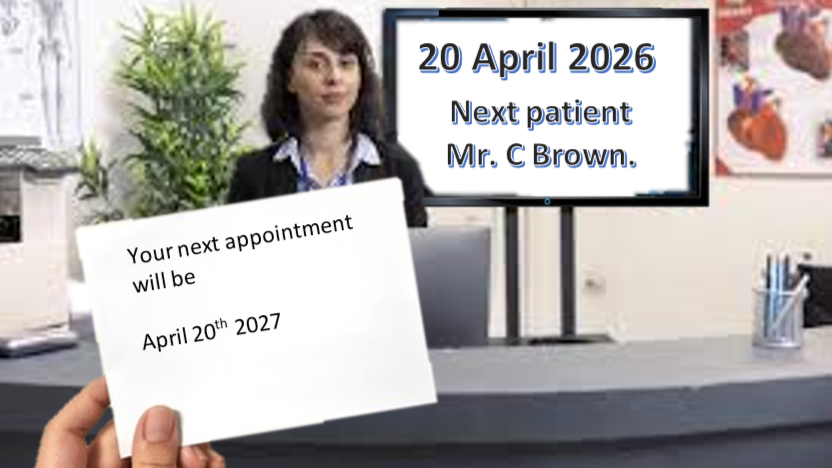
Recently, I attended my routine six-monthly pain clinic appointment. Barely a month later another letter arrived, dated 10 April, informing me that I needed to attend on 20 April. It seemed rather soon after my previous visit, but my daughter and I dutifully turned up ready for action on the appointed day.
We got to the receptionist desk only to find that she could not find any record of the appointment, which left me feeling that I had wasted my daughter’s time, but it turned out that the appointment letter was dated April 18th 2026, giving notice of an appointment on April 20th 2027!
I try to be a little early for such appointments because I am always aware that the clinic’s time is valuable too, but being a whole year early is about the most over-punctual I have ever been…
DS, Bellingham.